
Most clinicians who ask us how to start a private practice already know how to take care of patients. What they do not have is a clear order of operations. They have a list of forty tasks pulled from three different websites, no idea which ones actually gate the others, and a growing sense that the whole thing will take a year. That is the gap this guide is meant to close.
Below is the sequence we use at Practice Launch 90 when we walk a clinician from the decision to open through the first patient visit. It is written for nurse practitioners, therapists, physician associates, physicians, dietitians, and any other licensed clinician who wants to own the practice they work in. If you would rather have someone build the plan with you, you can book a free strategy session at any point, and we will map your specific situation.
Almost every delay we see when clinicians learn how to start a private practice on their own comes from doing steps out of order. A common example: a clinician signs a lease, then starts insurance credentialing, then discovers the credentialing timeline will run 90 to 180 days per payer. The rent is due while the practice has no way to bill. Another example: choosing an EHR before deciding whether the practice will accept insurance, then finding the system cannot handle claims the way the practice needs.
The seven steps below are ordered so that the slow items start first and the dependent items follow. That single change is most of what separates a launch that takes roughly a year from one that reaches operational readiness in about 90 days.
Before you form anything, answer four questions in writing. What services will you offer on day one? Will you accept insurance, run cash pay, or do a mix? Will you see patients in person, virtually, or both? What does a full week look like for you personally, in hours and in visit volume?
These answers drive nearly every downstream decision, including the cost to start a private medical practice, the EHR you select, the payers you enroll with, and the staffing you need. A virtual, cash pay behavioral health practice and an in person primary care practice that accepts Medicare are both private practices, but they are launched very differently.
Once you know what you are building, form the entity. Most clinicians land on a professional LLC, a PLLC, or a professional corporation, depending on state rules about which entity types licensed clinicians can use. Talk to an attorney and an accountant licensed in your state before you file, because corporate practice of medicine rules and tax elections vary.
In the same window, apply for an EIN with the IRS, open a business bank account, and obtain a Type 2 (organizational) NPI through the NPPES system at CMS. Your individual Type 1 NPI stays with you. The organizational NPI is what payers will attach to the practice. Get professional liability coverage quoted for the entity as well, since credentialing applications will ask for it.
This is the step that most guides on how to start a private practice bury in the middle. Move it up. If you plan to accept insurance, start payer enrollment the moment your entity, EIN, organizational NPI, and liability coverage are in place. Build or update your CAQH ProView profile, then submit applications to each commercial payer you want to work with. If you plan to see Medicare patients, enroll through PECOS.
Credentialing timelines are set by the payers, not by you, and they commonly run three to six months. Nothing you do later in the launch can compress them, which is why they start first. If you are unsure which payers are worth the effort in your market, that is a question worth bringing to a free strategy call before you submit anything.
This is where the question of the cost to start a private medical practice gets a real answer for your practice instead of a generic one. Build a simple startup budget with three parts: one time launch costs (entity formation, legal, initial technology, deposits, signage, initial supplies), recurring monthly costs (rent if any, EHR and telehealth subscriptions, liability insurance, billing service fees, payroll), and a working capital reserve that covers those monthly costs while credentialing finishes and claims start paying.
That third bucket is the one most clinicians underfund. Because credentialing takes months and the first insurance claims take weeks to pay after that, a practice can be seeing patients and still have very little cash coming in. Plan for it deliberately. If you are working with a private practice consulting partner, this pro forma is usually one of the first deliverables, because everything else is sized against it.
Select the EHR after Step 1 and Step 3, not before. The system needs to match your visit model (in person or virtual), your payer mix (insurance claims or cash pay invoicing), your specialty (behavioral health templates look nothing like primary care templates), and your budget. Confirm that the platform includes or integrates with electronic prescribing, a patient portal, telehealth if you need it, and a clearinghouse for claims.
Alongside the EHR, decide on a phone and fax solution, a secure email setup, and a scheduling tool if the EHR does not include one. Sign a Business Associate Agreement with every vendor that will touch protected health information. That is a HIPAA requirement, not a nicety.
A practice needs written policies before it opens: HIPAA privacy and security policies, a notice of privacy practices, financial and billing policies, a no show and cancellation policy, and clinical policies appropriate to your specialty. These are not paperwork for the sake of paperwork. They are what protect you in an audit, a complaint, or a dispute.
Once the policies exist, build the daily operations around them: intake forms, consent forms, the new patient workflow from first call to first visit, and the billing workflow from visit to claim to payment posting. If you are hiring, this is when job descriptions and onboarding get written.
Do not wait until the doors are open to tell anyone. Claim and complete your Google Business Profile, publish a simple website with your services, location or virtual availability, and a way to book, and start telling referral sources you are coming. For clinicians who accept insurance, ask to be listed in payer directories as soon as credentialing is approved. For cash pay practices, the referral network is even more important, because patients need a reason to choose you over an in network option.
Then open. Start with a manageable schedule, review every claim that goes out in the first month, and fix workflow problems while the volume is still small.
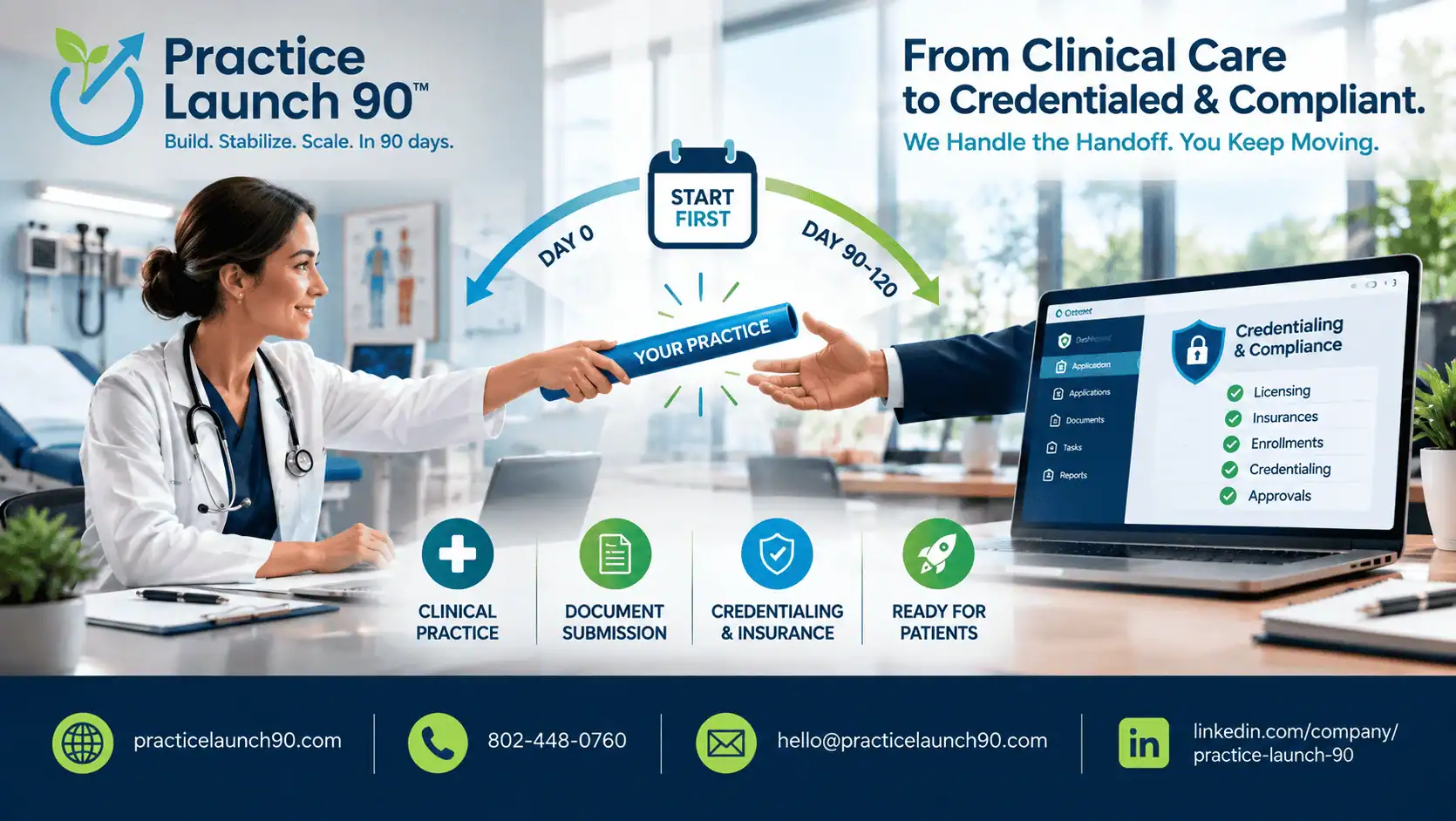
Clinicians ask us how long does it take to open a medical practice almost as often as they ask how to start one, and the answer depends heavily on whether you accept insurance and whether the slow steps started first. A traditional, self managed launch commonly takes about a year. When the sequence above is followed closely, operational readiness in about 90 days is realistic for many practices, with credentialing continuing in the background for payers that take longer.
That 90 day practice launch plan is the structure we built Practice Launch 90 around. The plan does not remove the credentialing wait. It makes sure everything else is finished by the time credentialing clears, so the practice is not sitting idle.
Ready to stop reading and start building? Book a free strategy session and we will walk through your practice type, your state, and your timeline, and tell you plainly where the risks are.
Not every clinician needs private practice consulting to open. Some have a business background, time to spare, and a simple practice model. If that is you, the seven steps above are enough to work from.
Where private practice consulting earns its cost is when time is scarce, the model has moving parts (insurance, staff, multiple locations, a specialty with unusual compliance requirements), or the clinician has already lost months to trial and error. In those cases, a structured 90 day practice launch plan with named deliverables, a pro forma, and someone accountable for sequencing usually pays for itself in avoided delay alone.
At Practice Launch 90, we work with practices at every stage, from first launch through stabilizing and scaling mature multi provider groups. If you are somewhere in the middle of figuring out how to start a private practice and want a second set of eyes on your plan, request a free consultation and bring your list. We will tell you what is in the right order and what is not.
No. Many behavioral health, psychiatric, dietitian, and some primary care practices launch virtually and add space later. Whether you need an office depends on your specialty, your state’s telehealth rules, and your patients. Starting virtual also lowers the cost to start a private medical practice significantly.
There is no single right answer. Insurance brings volume and patient access but adds credentialing time and billing complexity. Cash pay is faster to launch and simpler to run but requires a stronger referral and marketing plan. Many practices start with a small number of payers plus cash pay and expand later.
Decide what you are building (Step 1) and write it down. Every other step, including the entity type, the credentialing plan, and the technology, depends on that decision.
Yes. The sequence is the same for NPs, therapists, physician associates, physicians, and dietitians. The differences are in state scope of practice rules, which payers enroll which clinician types, and which policies are required for the specialty.
Most self managed launches take about a year, mainly because credentialing starts late and steps are done in parallel that should have been done in sequence. A structured 90 day practice launch plan changes that by starting the slow items first.
It varies by firm. At Practice Launch 90, a launch engagement includes a 5 Domain diagnostic, a sequenced 90 day practice launch plan, a financial pro forma, credentialing and technology guidance, policy templates, and a weekly working session with a consultant who is accountable for keeping the launch on schedule.
One last invitation. If this guide helped you see the order of operations, the next step is a conversation. Book your free strategy session and we will turn the seven steps into a dated plan for your practice.