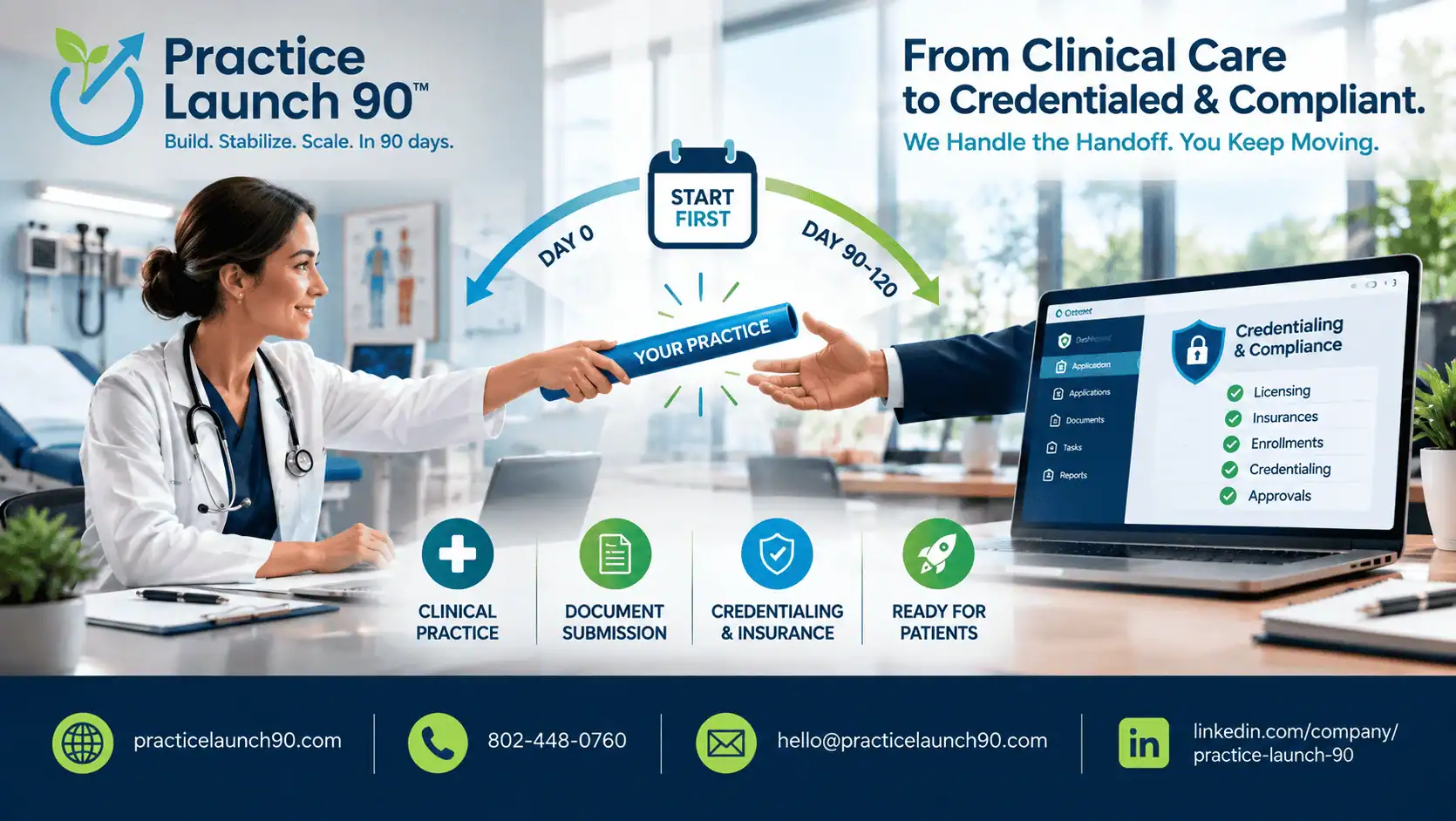
If there is one process that decides whether a new practice opens on schedule, it is insurance credentialing for new practice owners who intend to bill payers. Credentialing is slow, it is controlled entirely by the payers, and it cannot be rushed once an application is submitted. What you can control is when it starts, how clean the submission is, and what the practice does while it waits.
This article lays out insurance credentialing for new practice launches as a timeline, from the documents you need before you touch an application through the first paid claim. It is written for nurse practitioners, therapists, physician associates, physicians, and other licensed clinicians who plan to accept insurance. If you are already behind on this step, book a free strategy call and we will look at where the delay actually is.
Clinicians use these words interchangeably, and the payers do not. Credentialing is the payer verifying your license, education, training, work history, malpractice history, and sanctions status. Contracting is the payer agreeing to a participation agreement and fee schedule with your practice entity. Enrollment is the administrative act of loading you and your practice into the payer’s system so claims can be paid. Medicare uses the word enrollment for the whole process through PECOS.
When someone asks how to enroll with insurance as provider for the first time, they usually mean all three. Understanding that they are separate steps explains why an approval letter does not always mean you can bill yet, and why an effective date can differ from an approval date.
Insurance credentialing for new practice entities cannot begin until the entity exists in the eyes of the government and the payers. Before the first application, you need:
NPI registration for private practice is frequently the item that stalls everything, not because it is difficult (the NPPES application is free and usually processed within days), but because clinicians assume their individual NPI is enough. It is not. Payers attach contracts to the organizational NPI, so get it early.
Spend the first week assembling one folder that holds every document a payer might ask for. That includes state license(s), DEA registration if applicable, board certification, diploma or transcript, CV in month and year format with no unexplained gaps, malpractice certificate, malpractice claims history if any, government issued ID, W9 for the entity, the organizational NPI confirmation, and the entity formation documents.
Then update CAQH ProView. Most commercial payers pull directly from it, so an incomplete or unattested profile is the most common reason an application sits untouched. Add the new practice location, attach the documents, authorize the payers you intend to apply to, and attest. Set a reminder to re attest on the schedule CAQH requires, because an expired attestation quietly stops applications.
Before submitting, decide which payers matter in your market. Not every plan is worth the administrative cost. Look at which plans your likely patients carry, which pay reasonable rates for your specialty and codes, and which have a history of closed panels in your area. This is a place where payer enrollment consulting earns its fee, because a consultant who works these panels regularly knows which applications are likely to be accepted and which are a waste of a quarter.
Submit all chosen applications in the same window rather than one at a time. Each payer’s clock runs independently, so staggering submissions only stretches the total launch timeline. For Medicare, complete the PECOS enrollment for both the individual and the group. For Medicaid, follow your state’s process, which often includes a separate managed care organization enrollment after the state approval.
Not sure which payers are worth applying to in your state and specialty? Book a free strategy session and we will review your target payer list before you submit.
Commercial payer credentialing commonly takes 90 to 120 days from a complete submission, and some payers run closer to 180 days. Medicare and Medicaid timelines vary by contractor and state. During this window, the single most valuable habit is a follow up cadence. Call or check each payer’s portal every two to three weeks, record the date, the representative or reference number, and the stated status, and respond to any request for additional information the same day it arrives.
Applications do not usually fail. They stall. A missing signature, an expired malpractice certificate, a CV gap with no explanation, an address mismatch between CAQH and the application, or a lapsed CAQH attestation will put an application in a hold status that nobody at the payer is responsible for noticing. Your follow up is what surfaces it.
An approval is the beginning of the contracting and enrollment steps, not the end of the process. When a payer approves you, confirm the effective date in writing, ask whether retroactive billing to the effective date is permitted, confirm the fee schedule and participation agreement are executed, and confirm the practice appears in the payer’s provider directory. Then run a test claim as soon as you have an eligible patient, and watch the remittance carefully. If you are still learning how to enroll with insurance as provider and practice at the same time, this is the moment where the two paths finally connect.
For Medicare specifically, ask your contractor about the effective date rules and whether claims for services provided during the application window can be submitted. The rules exist, but they are specific, and a wrong assumption here can cost a practice a quarter of revenue.
Over many launches, the same handful of errors cause the majority of credentialing delays:
A provider credentialing consultant does not make the payers move faster. What a good one does is prevent every item on this list, keep the follow up cadence when you are busy seeing patients, and know which payers are worth the effort in the first place.
The waiting period is not dead time. This is when the EHR gets configured, the policies get written, the website and Google Business Profile go live, the intake workflow gets tested, and the referral network gets built. Practices that use this window well are ready to bill the day the first approval clears. Practices that do not are still building a website in month four, which is why we treat insurance credentialing for new practice launches as the backbone of the schedule rather than one task on a list. If you want a structured plan for the waiting months, that is exactly what our 90 day framework is designed to provide, and a free consultation is the fastest way to see whether it fits.
If you have the time, the master file, and the discipline to follow up every two weeks, you can manage insurance credentialing for new practice launches yourself. Many clinicians do.
Consider payer enrollment consulting or a provider credentialing consultant when you are still employed and launching on the side, when you are applying to more than five or six payers, when you are enrolling more than one clinician, or when you have already had an application stall and do not know why. At Practice Launch 90, credentialing guidance is built into the launch engagement, and for clinicians who only need this one piece, we can point you to the right partner. Either way, request a free strategy call and we will tell you which situation you are in.
Plan for 90 to 120 days per commercial payer from a complete submission, and allow up to 180 days for slower payers. Medicare and Medicaid vary by contractor and state. Because each payer runs on its own clock, submitting all applications in the same window keeps the total timeline shortest.
You can see patients, but you generally cannot bill an insurer as an in network provider until your effective date. Some practices see cash pay patients or bill out of network during the wait, if the patient’s plan and your state allow it. Ask each payer about retroactive billing rules in writing.
Yes, if you bill under a practice entity. NPI registration for private practice at the organizational level (Type 2) is separate from your individual Type 1 NPI. Both are free through NPPES.
Credentialing is the payer verifying your qualifications. Enrollment is loading you into the payer’s system so claims pay. Contracting sits between them. Most clinicians use one phrase for all three, which is fine as long as you track all three steps to completion.
It depends on your time and your payer list. For a solo clinician applying to two or three payers with time to follow up, probably not. For a clinician launching while still employed, applying to many payers, or enrolling multiple providers, a provider credentialing consultant usually saves more in avoided delay than the fee.
Ask for the appeal or waitlist process in writing, and ask what would qualify as an exception (a specialty shortage in the area, a specific language, a rural location). Then decide whether to wait, apply elsewhere, or build a cash pay option for that plan’s members.
The credentialing clock starts when you submit, not when you decide. If you want help getting a clean submission out this month, book a free strategy session and bring your payer list.