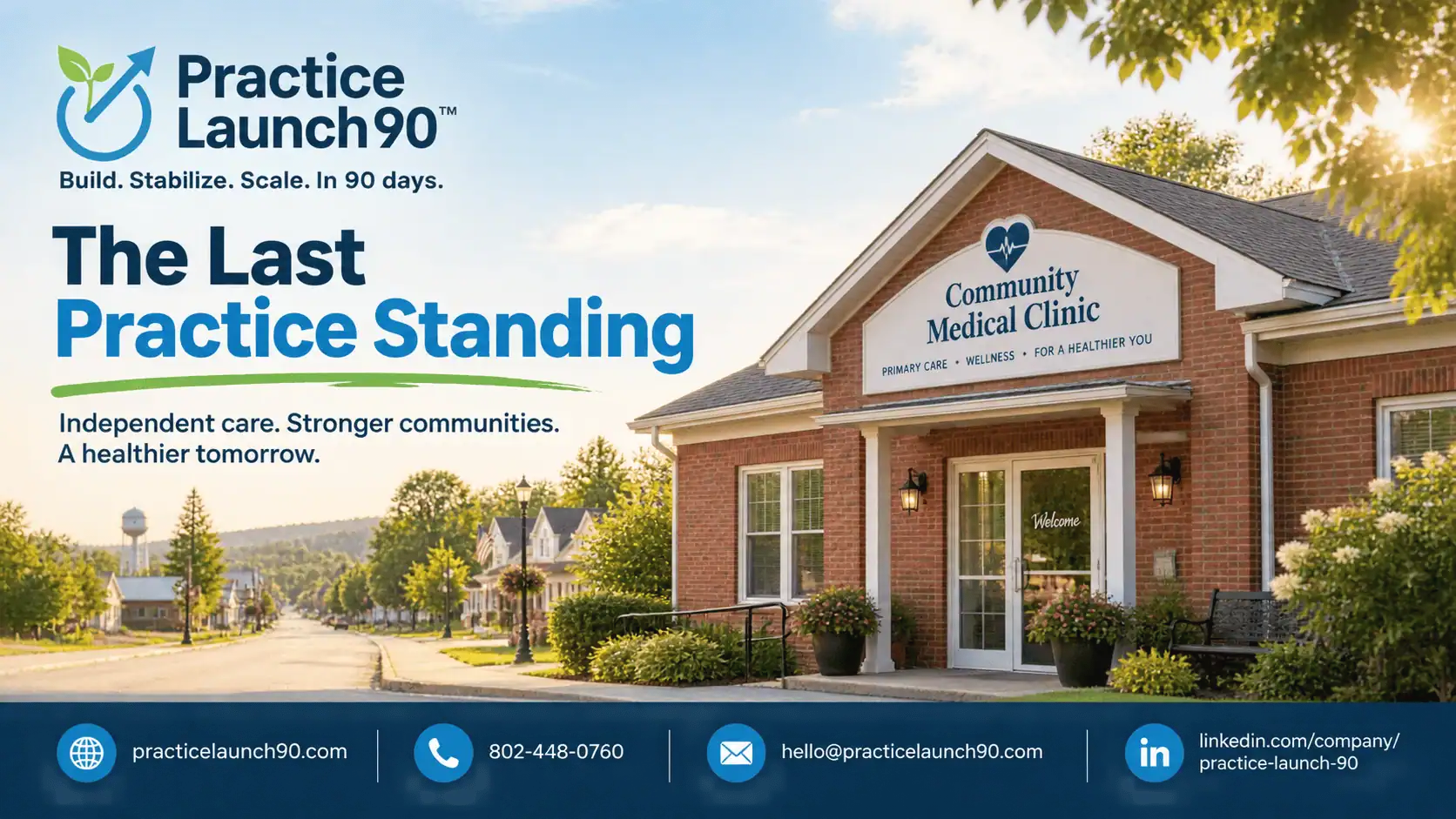
When a rural hospital closes, the news coverage focuses on the building. The photographs show the empty parking lot and the sign coming down. What the coverage usually misses is what remains: very often, a handful of independent clinicians, a family practice on the main street, a nurse practitioner who stayed. In community after community, the clinician owned practice is the healthcare infrastructure that is still standing after the institution has gone.
That observation is the starting point for an argument we will be carrying into the UVM Health Equity Summit on September 24 and 25, and it is worth laying out plainly here first. Independent practice is not nostalgia. It is infrastructure, and rural health policy should start treating it that way.
The State of the Rural Safety Net, in Numbers
The Chartis Center for Rural Health publishes an annual analysis of the rural safety net, and the 2026 edition describes a system under sustained strain. According to Chartis, 206 rural hospitals have closed or converted to models that exclude inpatient care since 2010. More than 40 percent of rural hospitals are operating at a loss, and 417 facilities are assessed as vulnerable to closure. Care deserts are widening as services such as obstetrics, chemotherapy, and general surgery disappear from rural communities entirely.
These numbers describe institutions. What they imply for people is longer drives, delayed care, and communities where the question is no longer which provider to choose but whether there is a provider at all. Any serious conversation about clinician ownership in rural health has to begin from that reality, not from an idealized picture of country medicine.
Claim One: Independent Practices Are Access Points, Not Accessories
In a community that has lost its hospital, the remaining independent practice is frequently the only local source of primary care, chronic disease management, behavioral health, or prenatal touchpoints before a long drive to delivery. It anchors referrals, coordinates with distant specialists, and keeps care local for the large majority of visits that never needed a hospital in the first place. Policy frameworks that count hospital beds as infrastructure but treat a clinician owned practice as a small business are measuring the wrong thing. Access is infrastructure, and in much of rural America today, the independent practice is the access, whether or not policy has caught up with that fact.
Claim Two: Clinician Owned Practices Are Built to Survive Where Institutions Cannot
A rural hospital carries enormous fixed costs, and the Chartis data shows how punishing that math has become. An independent practice carries a fraction of that overhead. It can run sustainably on a patient volume that could never support an inpatient facility, and it can adapt its service mix quickly because the person making decisions also sees the patients. This is not an argument against rural hospitals, which remain essential for emergency and inpatient care. It is an argument that the resilient layer of rural healthcare, the layer that persists through institutional failure, is disproportionately clinician owned, and that strengthening it is one of the most cost effective moves available to policymakers.
Claim Three: The Rural Workforce Is Increasingly Ready to Own
Nurse practitioners have become a central part of the rural workforce, and in many states they can practice with full authority. For a growing number of them, nurse practitioner private practice setup is the most direct route to serving a community that larger employers have left. The same is true for therapists, physician assistants working within their state frameworks, and physicians leaving consolidating systems. The question of clinician ownership in rural health is therefore not hypothetical. The people willing to own are already there. What they usually lack is not commitment but a launch path: credentialing, billing infrastructure, compliance, and a financial plan that works at rural volumes. Providing that path is precisely what a medical practice launch consultant is for.
Serving a rural community and considering ownership? Book a free strategy session and we will talk through what a viable practice looks like where you are.
What Policy Gets Wrong, and What It Could Get Right
Federal reviews and independent analyses have repeatedly associated healthcare consolidation with higher prices without consistent gains in quality. Yet most rural health investment still flows toward institutions and buildings, on the assumption that scale equals stability. The last decade of closures argues otherwise. A policy approach that treated clinician ownership in rural health as infrastructure would fund the unglamorous foundations that keep practices alive: startup support, credentialing assistance, technical help with billing and compliance, which is the daily work of a medical practice launch consultant, and sustainable payment for the primary care and behavioral health services rural practices actually provide.
Vermont is a useful test case. Our state’s rural communities have experienced service reductions and financial distress at the same time that a new wave of clinicians has shown interest in ownership. The infrastructure argument says: meet them there, and pairing seed support with an experienced private practice startup consultant would multiply the value of every dollar. Every practice that launches and survives in a rural town is an access point that no future institutional closure can take away.
How Practice Launch 90 Supports Rural Clinicians
Practice Launch 90 is the national practice transformation division of Vermont Healthcare Consulting, a Vermont based firm with more than a decade of work across rural hospitals, federally qualified health centers, behavioral health providers, and state agencies. As a medical practice launch consultant, we take clinicians from decision to operational readiness in about 90 days, and we build rural realities into the plan from the start: payer mix, realistic volumes, telehealth, and lean staffing models. For clinicians starting from zero, we serve as the private practice startup consultant who sequences every step in order. That includes nurse practitioner private practice setup, which is often the fastest route to restoring access in a town that has lost other options.
Whether you need a private practice startup consultant to get a first location open, help stabilizing an existing rural practice, or a partner for scaling into a second community, we structure the engagement around your stage, and our role as a medical practice launch consultant stays the same: build the foundation first. Rural practices do not fail for lack of patients. They fail for lack of operational foundation, and that is a solvable problem.
Ready to put a real plan behind your commitment to your community? Schedule your free strategy call.
Frequently Asked Questions
Why are so many rural hospitals closing?
The core drivers are financial: low patient volumes against high fixed costs, thin or negative operating margins, and reimbursement pressure. The 2026 Chartis analysis found more than 40 percent of rural hospitals operating at a loss and 417 vulnerable to closure.
What happens to a community when its rural hospital closes?
Residents travel farther for emergency and inpatient care, some services such as obstetrics may disappear from the region entirely, and local jobs are lost. Outpatient care often continues through independent practices that remain, which is why supporting them matters so much.
Can a nurse practitioner open an independent practice in a rural area?
In many states, yes, including states with full practice authority where physician oversight agreements are not required. Requirements vary by state, so nurse practitioner private practice setup should always start with a review of your state’s practice laws and payer rules, ideally with a medical practice launch consultant familiar with rural payer mixes.
What is a care desert?
A care desert is an area where a specific service, such as obstetrics, chemotherapy, or general surgery, is no longer available locally. Chartis and other analysts have documented these deserts expanding across rural America as hospitals close or cut service lines.
Are independent practices financially viable at rural patient volumes?
Many are, because their cost structure is far leaner than a hospital’s. Viability depends on a realistic financial model, an efficient billing operation, and a service mix matched to community need. A private practice startup consultant can pressure test that model before you commit to a lease or a resignation letter.
What support exists for clinicians who want to open a rural practice?
Options include loan repayment and workforce programs, state and federal rural health initiatives, and practical support for credentialing, billing, and business setup from a private practice startup consultant focused on your stage. The right combination depends on your state and specialty.
The Argument, in One Paragraph
Rural healthcare is losing institutions faster than it can replace them, and the layer that endures is clinician owned. Treating clinician ownership in rural health as infrastructure means funding practice viability with the same seriousness we fund buildings, because a practice that stays open is access that a closure cannot erase. That is the case we will be making at the summit, and it is the case we make every time a clinician asks us whether their community can support a practice. More often than the headlines suggest, the answer is yes, with the right foundation and the right medical practice launch consultant beside you. A private practice startup consultant cannot change rural economics, but the right plan can make a practice durable inside them.
Join the conversation, or start your own launch. Book a free strategy session with Practice Launch 90.