
Anyone who gives you one number for this is guessing.
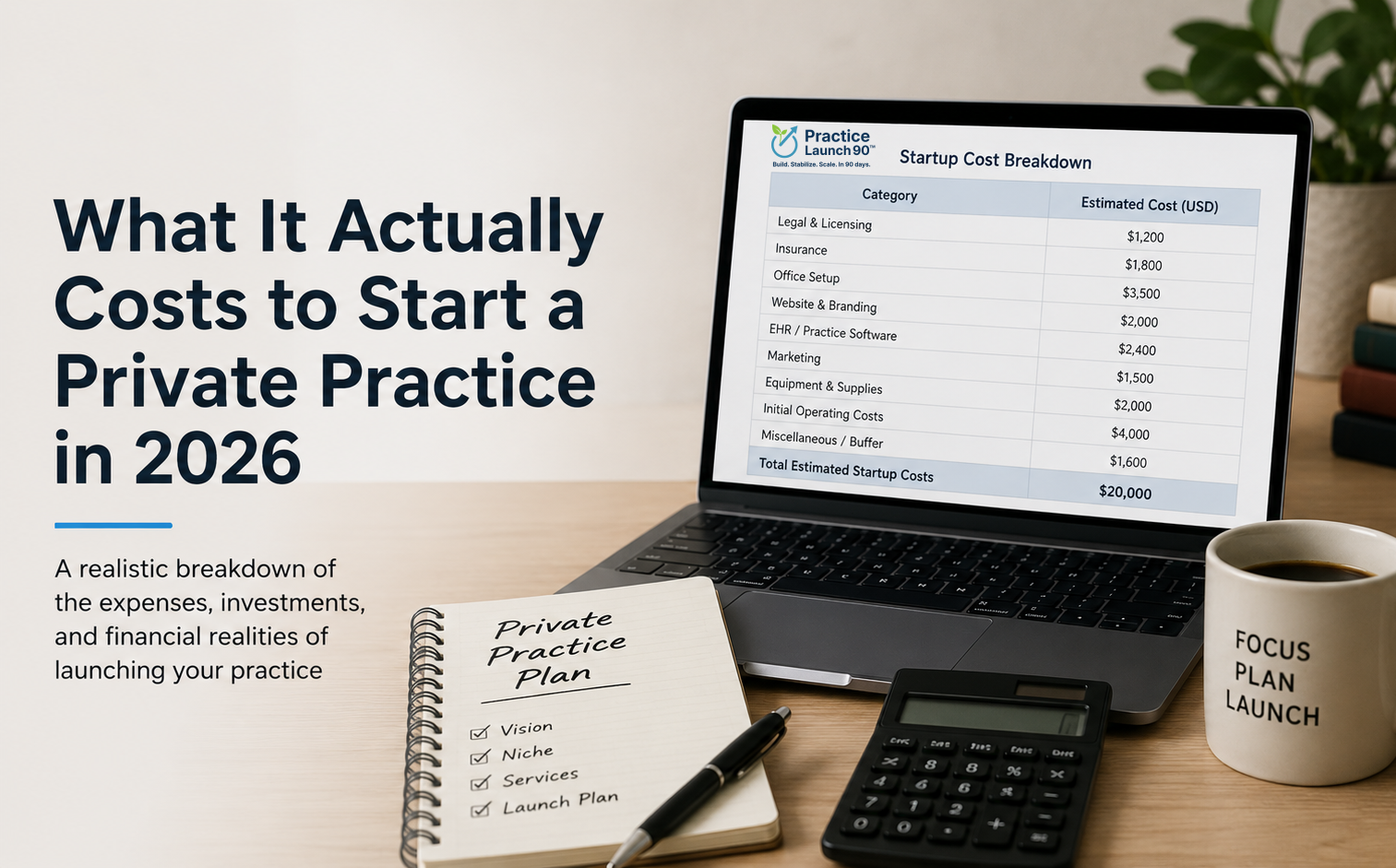
The cost to start a medical practice in 2026 depends on four things: your care model, your specialty, your local market, and how long you can operate before money comes in. A telehealth-first solo practice and a procedure-based practice with a full build-out are not the same business, and no national average describes both.
So I am not going to hand you an average. I am going to hand you something more useful: every category you will actually pay for, the real national data where it exists, and an honest note where the only correct answer is “this one is local, go get three quotes.” Where I have a named source with a date, I name it. Where I do not, I say so.
I spent a morning tracing the numbers that come up when clinicians search this question. Most pages quoting a startup range attribute it to a well-known benchmarking organization or to “industry data,” without naming a report, a year, or a table. Several cite each other. A few cite nothing at all.
That is not a small problem. If you are deciding whether to leave an employed position, you are making one of the largest financial decisions of your career using a number that has no traceable origin. You would never accept that standard for a clinical decision. You should not accept it here either.
Here is what I can tell you with a source attached, and where the gaps really are.
Staffing is the biggest line in most practice budgets, and it is the one clinicians underestimate most reliably. The good news is that this is one of the few categories where genuinely reliable public data exists.
From the U.S. Bureau of Labor Statistics Occupational Employment and Wage Statistics survey, May 2025 national estimates, mean annual wages were:
| Role | Mean annual wage | What this covers |
|---|---|---|
| Medical assistants | $46,120 | Rooming, vitals, clinical support, often front desk overlap in a small practice |
| Medical secretaries and administrative assistants | $46,800 | Scheduling, intake, phones, insurance verification |
| Registered nurses | $101,420 | Triage, care coordination, higher-acuity support |
| Nurse practitioners | $137,300 | A second clinician, once you are ready to add one |
| Physician assistants | $141,280 | A second clinician, once you are ready to add one |
Source: U.S. Bureau of Labor Statistics, Occupational Employment and Wage Statistics, national employment and wage data by occupation, May 2025.
Now the part that catches people. A salary is not payroll. Employers also pay for insurance, retirement contributions, paid leave, and legally required benefits such as payroll taxes and unemployment insurance. BLS tracks this directly: in March 2026, wages and salaries made up 69.9 percent of total employer compensation costs for private industry workers, and benefits made up the remaining 30.1 percent (Bureau of Labor Statistics, Employer Costs for Employee Compensation, March 2026, released June 12, 2026).
In plain terms, plan for roughly a third on top of every salary figure above. A medical assistant budgeted at $46,000 is realistically closer to $60,000 in true employer cost. Two staff members are therefore a six-figure commitment before you have seen a single patient.
One more practical note. BLS publishes these figures by state and by metropolitan area, not just nationally. Use the number for your own market. The national figure is a starting point, not your budget.
There is no honest national number here, and anyone who gives you one is averaging a rural Vermont storefront with a Boston medical office tower. Rent, tenant improvement allowances, permitting, and construction costs are entirely local.
What I can tell you is what to ask. Get three quotes. Ask every landlord whether there is a tenant improvement allowance and what it actually covers. Ask what the permitting timeline looks like in that municipality for a clinical use change, because a build-out delay costs you rent and payroll simultaneously.
This is also the category where your care model changes the answer most dramatically. Telehealth-first practices carry very little of this cost, and that model is now mainstream rather than experimental: the share of physicians in practices using telehealth rose from 25.1 percent in 2018 to 71.4 percent in 2024, according to the American Medical Association’s Physician Practice Benchmark Survey.
Your electronic health record, dental practice management consulting, clearinghouse, phones, secure messaging, and devices. The advertised monthly price per provider is rarely the real cost. Implementation fees, data migration, training hours, interface charges, and contract exit terms are where the money hides.
Ask every vendor for total cost of ownership over thirty-six months, in writing, including everything that is not the monthly subscription. If a vendor will not put that in writing, that is information too.
The direct fees here are smaller than most people expect. For calendar year 2026, the Medicare, Medicaid, and CHIP provider enrollment application fee for institutional providers is $750. Importantly, physicians and non-physician practitioners do not pay a Medicare enrollment application fee at all (Centers for Medicare and Medicaid Services, MLN9658742, Medicare Provider Enrollment, updated for 2026; Federal Register notice published December 3, 2025).
So the fee is not the cost. The cost is time. Enrollment and payer credentialing determine when you can bill, and that timing drives everything in the next section. I am covering that question fully in the next article in this series, because it deserves its own piece.
Malpractice coverage, general liability, cyber liability, workers compensation, entity formation, lease review, and employment agreements. Malpractice premiums in particular vary enormously by specialty and by state, so a national figure would mislead you. Get real quotes for your specialty in your state, and get them before you sign a lease, not after.
This is the category clinicians discover late. It is not a folder of templates. One telehealth-first women’s health practice we supported needed a thirty-two document policy set covering consent and patient rights, clinical and prescribing protocols, financial policies, multi-state licensure, HIPAA security and breach response, human resources, and compliance.
Thirty-two documents is not unusual. It is what a real operating practice needs, and building it is either your time or someone else’s fee. Both are a cost.
This is where specialty drives the number harder than anything else. A behavioral health practice and a practice doing in-office procedures are separated by an order of magnitude here. Build your list from your actual scope of service, then price it, then decide what to lease instead of buy.
Working capital.
You will pay staff, rent, and vendors from your first week. You will not collect from payers on that schedule. That gap is not a rounding error; for many new practices it is the single largest financial risk of year one, and it is the one that quietly ends practices that were otherwise viable.
Some of that gap can be recovered. CMS enrollment rules allow physicians and groups enrolling in Medicare Part B an effective date up to thirty days before the date the contractor receives the application, which means some early services can be billed retroactively once enrollment is approved. That helps your eventual revenue. It does not help you make payroll in month one.
So the honest planning question is not “what does it cost to open?” It is “how many months can I cover everything with no meaningful collections?” Answer that number first. It is the constraint that determines whether the rest of your plan is real.
From our own pro forma work at Practice Launch 90: [JENN TO INSERT: the working capital range you are willing to stand behind publicly, stated as months of operating expense rather than a dollar figure, plus the assumption behind it. Example structure: “Across the practices we have modeled, the working capital reserve that held up ran from X to Y months of full operating expense, assuming Z.”]
Your own income. Most startup lists quietly assume you are living on air. You are not. Whatever you need to cover your household during the ramp is a real requirement of the plan, and it belongs in the plan even though it is not a business expense. Leaving it out is the fastest way to make a workable model look better than it is.
Your time. The months you spend evaluating vendors, writing policies, chasing enrollment, and sitting on hold with payers are months you are not seeing patients. That is not free. It is the cost that clinicians most often pay without ever putting a number on it, and it is usually the largest hidden line in the whole project.
Doing it twice. The lease signed before the malpractice quote came back. The EHR chosen before anyone asked about the exit terms. The policy set assembled from templates and then rebuilt after the first payer audit. Rework is expensive, and almost all of it comes from sequencing decisions in the wrong order rather than from making bad decisions.
Most new practices use some combination of personal savings, a bank or credit union loan, equipment leasing, and SBA-backed financing. It is worth knowing what the federal programs actually allow, because the terms are more flexible than clinicians tend to assume.
SBA 7(a) is the agency’s primary business loan program, and short-term and long-term working capital is an explicitly eligible use, alongside equipment, furniture, and leasehold improvements. The maximum 7(a) loan amount is $5 million, and SBA does not require collateral on loans of $50,000 or less (U.S. Small Business Administration, 7(a) loan program, terms, conditions, and eligibility).
There is also a recent change worth knowing about. As of July 4, 2026, eligible borrowers may combine 7(a) and 504 financing for up to $10 million in total SBA-backed financing, up from a previous cumulative limit of $5 million (U.S. Small Business Administration announcement, July 2026). For most solo and small-group practices that ceiling was never the binding constraint. The point is that working capital is fundable, and clinicians routinely borrow only for equipment and build-out while covering the ramp out of personal savings. That is usually the wrong split.
Here is what I have learned watching clinicians open practices: the ones who struggle are rarely the ones who underestimated the total. They are the ones who underestimated the gap between opening the doors and getting paid.
Ownership is achievable, and the data suggests more clinicians should be considering it, not fewer. The share of physicians in private practice fell from 60.1 percent in 2012 to 42.2 percent in 2024, and the share holding an ownership stake fell from 53.2 percent to 35.4 percent over the same period (American Medical Association, Physician Practice Characteristics in 2024, Policy Research Perspectives by Carol K. Kane, PhD, published May 2025, based on a survey of 5,000 physicians fielded in August and September 2024). That trend is not primarily about clinical ability. It is about operational difficulty, and operational difficulty is a solvable problem.
If you are running these numbers right now, what is the category you are least sure about? That is usually the one worth pressure-testing first.
How much does it cost to start a medical practice in 2026?
There is no single reliable national figure, and the ranges published online generally do not have a traceable source. The honest answer is that your number is built from seven categories: staffing, space and build-out, technology, enrollment and credentialing, insurance and legal, policies and compliance, and equipment. To that you add working capital, which is the reserve that covers your expenses until payer collections begin. Your care model and specialty change the total more than any other factor.
What is the biggest startup cost for a new practice?
For most office-based practices it is people. Using U.S. Bureau of Labor Statistics data from May 2025, the mean annual wage was $46,120 for medical assistants and $46,800 for medical secretaries and administrative assistants. Benefits and legally required employer costs add roughly a third on top: BLS reported in March 2026 that benefits made up 30.1 percent of total employer compensation costs in private industry. Two staff members are a six-figure annual commitment before you see a patient.
How much working capital do I need before I open?
Think in months of full operating expense rather than a dollar figure, because the right amount depends on your payer mix and how quickly you are credentialed. The question to answer is how long you can cover payroll, rent, and vendors with no meaningful collections. That number, not the startup total, is usually what determines whether a practice makes it through year one.
Does Medicare charge a fee to enroll a new practice?
For calendar year 2026, the Medicare, Medicaid, and CHIP provider enrollment application fee for institutional providers is $750. Physicians and non-physician practitioners do not pay a Medicare enrollment application fee. This is set out in CMS MLN9658742, Medicare Provider Enrollment, updated for 2026. The fee is small relative to the real cost of enrollment, which is the delay before you can bill.
Is it cheaper to start a telehealth practice?
Generally yes, because a telehealth-first model removes or shrinks the space and build-out category, which is one of the largest and most variable costs. It does not remove technology, compliance, credentialing, or working capital needs, and multi-state licensure adds complexity of its own. Telehealth is also no longer a fringe model: the American Medical Association found that 71.4 percent of physicians were in practices using telehealth in 2024, up from 25.1 percent in 2018.
Can I open before my insurance credentialing is finished?
Many practices do, using private pay or the payers that approve first, and CMS rules allow physicians and groups enrolling in Medicare Part B an effective date up to thirty days before the contractor receives the application, which permits some retroactive billing once enrollment is approved. That is a real advantage, but it does not solve the cash-flow gap in your opening weeks. Plan the opening around when money actually arrives, not around when claims are submitted.
Jenn Mayhew, MPH, PMP, LSSGB, is the founder and principal consultant of Vermont Healthcare Consulting, LLC, and leads Practice Launch 90, the firm’s national practice transformation division. She has more than thirteen years of consulting experience across hospitals, federally qualified health centers, behavioral health providers, state agencies, and nonprofits, and was named the 2026 SBA Vermont Woman-Owned Small Business of the Year. Vermont Healthcare Consulting is a certified Woman-Owned Small Business and Economically Disadvantaged Woman-Owned Small Business.
Practice Launch 90, a national division powered by Vermont Healthcare Consulting.