Most conversations about burnout in medicine start from the assumption that the work itself is the problem. Long hours, heavy documentation, and emotionally demanding patient care are real, and no practice model makes them disappear. Yet one of the most striking findings in the burnout literature suggests that the setting in which clinicians work may matter far more than most of us were taught to believe.
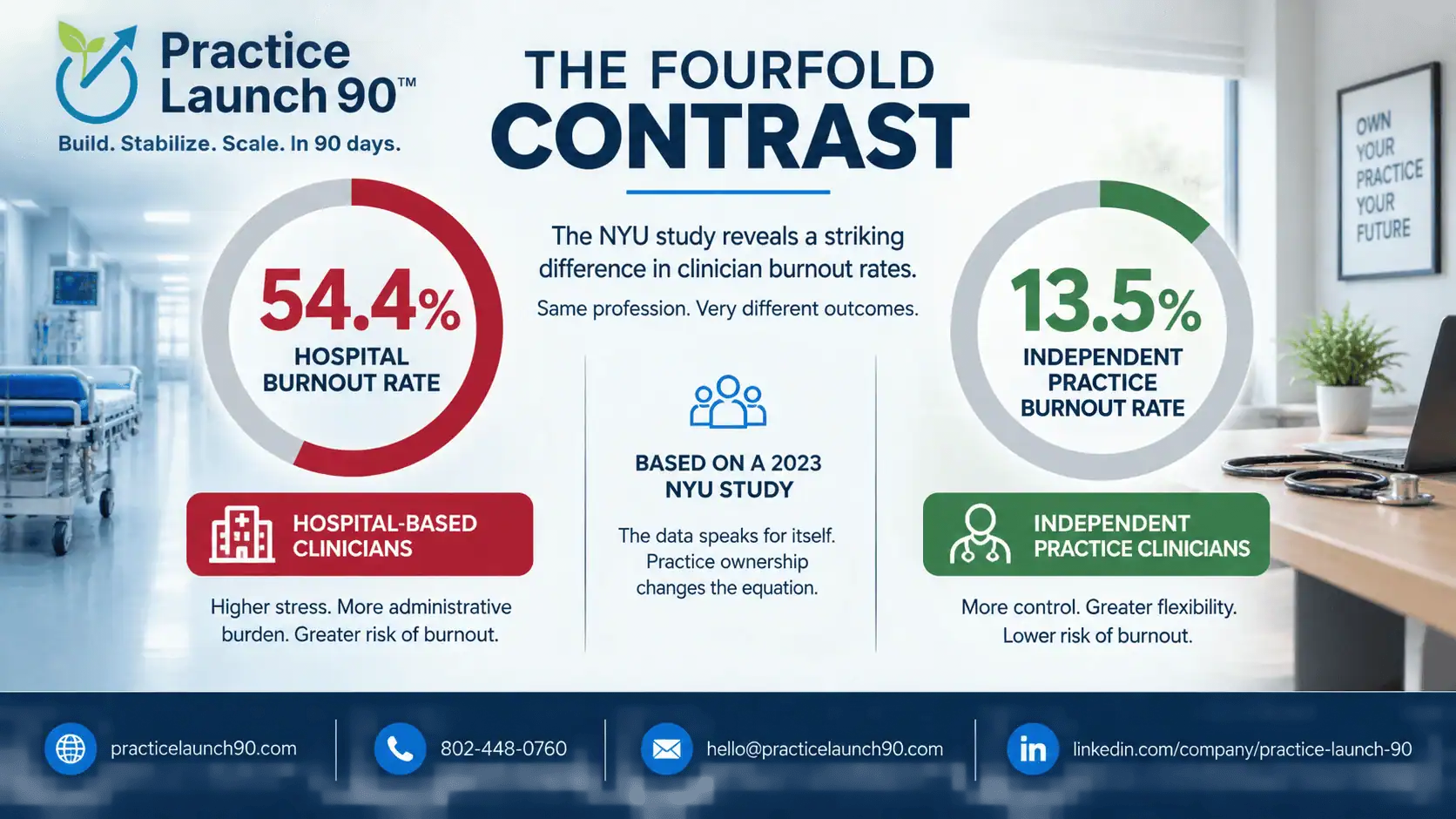
In 2018, researchers led by the NYU School of Medicine published a study in the Journal of the American Board of Family Medicine that measured burnout among providers working in small independent primary care practices in New York City. The rate of reported burnout was 13.5 percent. National survey data from 2014, published by Shanafelt and colleagues, estimated that 54.4 percent of United States physicians reported at least one symptom of burnout. That is a fourfold difference, and it deserves both attention and honest interpretation. This article aims to give it both.
The Number That Should Change the Conversation
The study, by Blechter and colleagues, surveyed 235 providers working across 174 small independent primary care practices. Most respondents were physicians, and the sample also included nurse practitioners and physician assistants. These were everyday urban primary care practices operating under the same payment system, the same documentation requirements, and the same regulatory environment as everyone else. They were not concierge clinics with unusual resources. What they had, structurally, was ownership and autonomy.
A 13.5 percent burnout rate in that setting stands in sharp contrast to what has been reported in surveys dominated by hospital based and large group settings. The study authors concluded that the independence and autonomy providers have in these small practices may offer some protection against symptoms of burnout. That conclusion lines up with a broader body of research linking perceived autonomy to lower burnout across countries and specialties.
What the Study Does Not Prove
We hold our content to the same evidence standards we would use in a public health classroom, and honest private practice consulting depends on the same discipline, so it matters to say clearly what this study can and cannot support.
First, the study was a snapshot in time rather than a study that followed clinicians over years, which means it can show an association but cannot prove that practice ownership causes lower burnout. Clinicians who choose ownership may differ from those who do not, and clinicians who burned out in ownership may have already left it. Second, burnout was measured with a single validated question rather than the full Maslach Burnout Inventory, which is a reasonable and accepted approach but a less detailed one. Third, the comparison figure of 54.4 percent comes from a separate national survey with different methods, so the two numbers are best read as a strong signal rather than a precise head to head comparison. Fourth, the sample came from New York City, and urban primary care may not generalize perfectly to every specialty or region.
None of these limitations erase the finding. A gap that large, in a sample that had no special financial advantages, is worth taking seriously. It simply should not be oversold, and we would rather earn your trust by representing the research honestly than by making a dramatic claim.
Why Ownership and Autonomy Appear to Protect Clinicians
The connection between physician burnout and private practice ownership makes sense when you look at what actually drives burnout. Research consistently points to loss of control over schedules, panels, and clinical decisions, along with a sense that daily work no longer reflects personal values. Ownership addresses those drivers directly. An owner decides how many patients to see, which payers to work with, what the visit length will be, and what the practice culture feels like.
The study also found something subtler. Practices with higher adaptive reserve, which is a measure of a practice’s capacity to learn, adapt, and function as a team, showed meaningfully lower odds of provider burnout. In plain terms, it was not only independence that mattered. It was working inside a small organization healthy enough to change when something was not working. That is an encouraging finding, because adaptive capacity can be built deliberately, and it is one of the things good practice design is for.
I think there is a fair reading of this literature that goes like this: the question of physician burnout and private practice is not really about escaping hard work. It is about whether the structure around the work gives clinicians enough control to do the job the way they believe it should be done.
What This Means If You Are Considering the Move
For an employed clinician, the move from employed physician to independent practice can feel like trading one set of stresses for another, and in the early months that is partly true. Ownership does not remove administrative burden. It relocates it, and a poorly structured launch can create exactly the chaos people are trying to leave behind. Credentialing delays, billing problems, and cash flow surprises are their own path to exhaustion.
That is why we encourage clinicians to treat leaving hospital employment to start practice ownership as an operational project, not only an emotional decision. The evidence supports autonomy as protective. Autonomy, in turn, depends on a practice that runs well enough to give you real control rather than a second job doing paperwork at midnight. The clinicians we see thrive are the ones who built the business foundation before they saw their first patient, and closing that gap is exactly what good private practice consulting is for.
Thinking about what independence could look like for you? Book a free strategy session and talk it through with us before you make any decisions.
How Practice Launch 90 Supports Clinicians
Practice Launch 90 is the national practice transformation division of Vermont Healthcare Consulting. We provide private practice consulting for nurse practitioners, therapists, physician assistants, and physicians, whether they are launching a new practice, stabilizing an existing one, or scaling a mature group. Our structured framework moves a clinician from decision to operational readiness in about 90 days, covering business structure, credentialing, billing setup, compliance, and the day to day systems that protect your time.
Because our roots are in healthcare operations rather than generic small business advice, our private practice consulting is built around the realities described in this research: autonomy only protects you when the practice underneath it is sound. The path from employed physician to independent practice is well traveled, and it goes far better with a map.
Ready to see what your first 90 days would look like? Schedule your free strategy call and we will walk you through the framework step by step.
Frequently Asked Questions
Is burnout really lower in private practice?
The best available study of small independent primary care practices found a 13.5 percent burnout rate, compared with a 2014 national estimate of 54.4 percent among physicians overall. The study shows a strong association rather than proof of cause, but the size of the gap is hard to ignore.
Why do small practices seem to protect against burnout?
The study authors point to independence and autonomy, meaning control over schedules, workflows, and clinical decisions. Practices with stronger capacity to learn and adapt as a team also showed lower odds of burnout.
Does owning a practice guarantee less stress?
No. Ownership relocates administrative burden rather than removing it. A practice with weak billing, credentialing, or cash flow systems can be just as exhausting as employment. The protective effect comes from autonomy supported by sound operations, which is what private practice consulting should deliver.
Is leaving hospital employment to start practice ownership realistic financially?
For many clinicians it is, but it requires honest planning around startup costs, working capital, and the credentialing timeline, since insurance payments take time to begin. We recommend building a conservative financial plan before resigning from anything.
How long does it take to open an independent practice?
The traditional path often takes close to a year. With a structured plan and the right sequencing of legal, credentialing, and billing tasks, a clinician can reach operational readiness in about 90 days. The timeline depends heavily on payer credentialing in your state, which is one reason structured private practice consulting shortens the path.
Does this research apply to nurse practitioners and therapists too?
The study sample included nurse practitioners and physician assistants alongside physicians, and the mechanisms it points to, autonomy and adaptive capacity, are not unique to any one license. The broader burnout literature suggests these findings are relevant across clinician types.
Start the Conversation
The research on physician burnout and private practice will keep growing, and we will keep reading it carefully. What we already know is enough to justify a serious look at ownership for clinicians who feel the mismatch between how they want to practice and how they are being asked to practice. If leaving hospital employment to start practice ownership has been on your mind, the most useful next step is a real conversation about your numbers, your timeline, and your goals. The move from employed physician to independent practice rewards preparation far more than bravado, and good private practice consulting should begin with listening rather than selling.
Take the first step today. Book your free strategy session with Practice Launch 90.