Somewhere around the middle of every practice launch, the policy question arrives, and the temptation is to solve it with a credit card. Buy a template pack, swap in your logo, save the folder, done. I understand the appeal, because by that point you are juggling credentialing, an EHR decision, and a lease, and policies feel like paperwork for its own sake.
They are not. Policies and procedures for a private practice are the operating instructions for your business, and they only protect you if they describe how your practice actually runs. Regulators and payers compare what you wrote down against what you did, so a binder of generic documents nobody has read can be worse in an audit than a thin set of policies you actually follow.
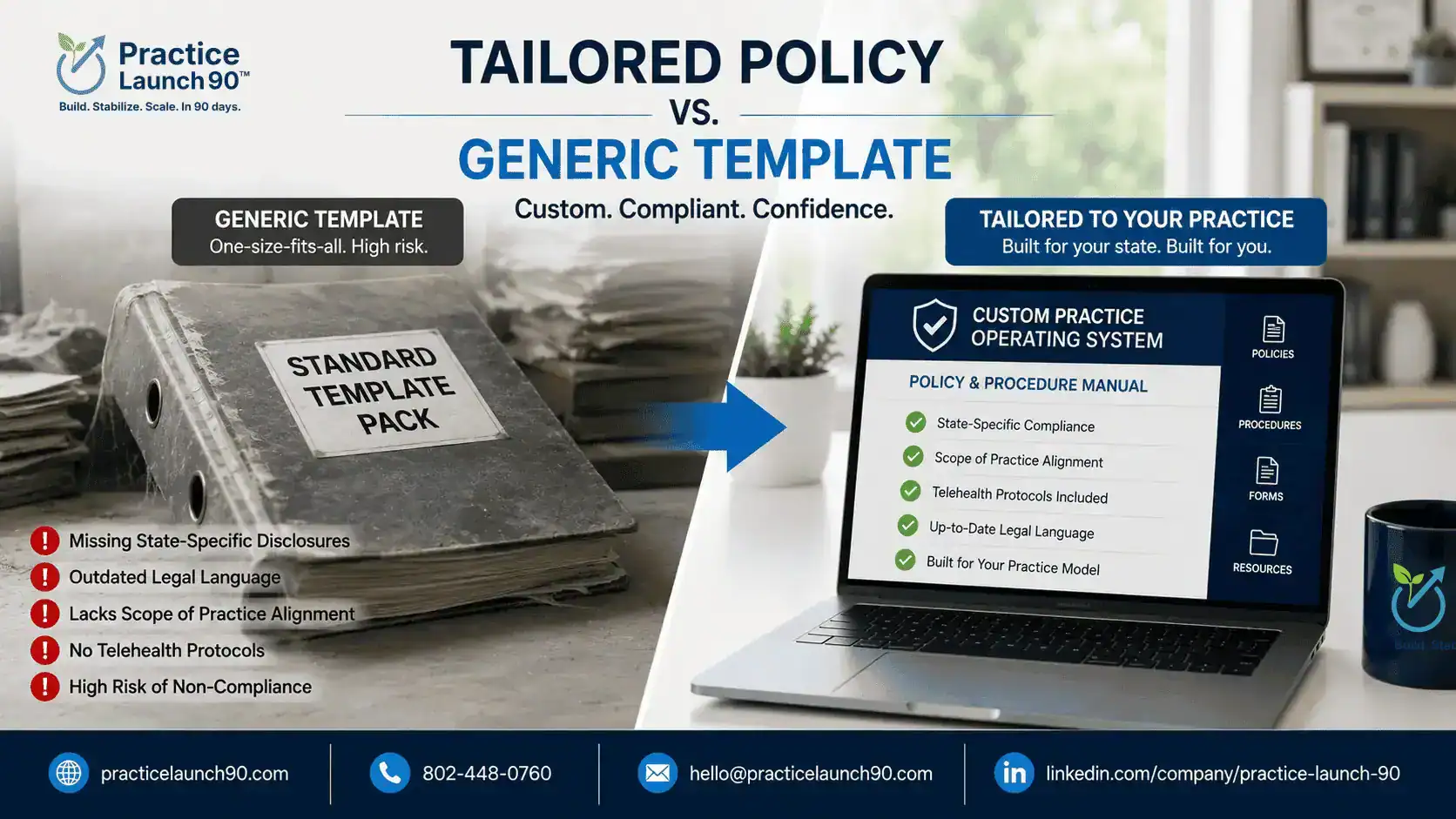
Templates fail for three reasons, and none of them is bad writing. First, they are built for a generic practice that does not exist; most packs quietly assume a brick and mortar office, one state, commercial insurance, and a front desk. Second, your real obligations attach to specifics: your state, your license, whether you prescribe controlled substances, whether you treat minors, whether you have employees, and how you take payment. A template cannot know any of that, so it either overreaches or leaves gaps, and the gaps are where the risk lives. Third, unread policies fail at the exact moment you need them, during a breach, a board complaint, or a payer audit, because a document your team has never seen guides no one’s behavior. Useful policies and procedures for a private practice have to start from your model, not from someone else’s table of contents.
Recently my team built the complete policy set for a women’s health practice designed around telehealth, serving patients in more than one state. The finished set came to thirty two documents, and the count was not padding. Every document answered a specific operational or legal question the practice was going to face in its first year, and that specificity is the whole argument. Here is what the set contained.
Informed consent for telehealth care, patient rights and responsibilities, release of information procedures, and consent for communicating by text and email, including what happens when technology fails mid visit.
Protocols aligned to the provider’s scope of practice, prescribing policies stating clearly what will not be prescribed through telehealth, and an emergency response protocol for a patient in crisis who is not in the room with you. That last one is the document I hope no practice ever uses, and the one I would never let a client launch without.
Self pay pricing, refunds, missed appointments, collections, and Good Faith Estimates. Under the No Surprises Act, CMS requires practices to give uninsured and self pay patients a Good Faith Estimate of expected charges, so a written procedure for producing and documenting those estimates belongs in any set of policies and procedures for a private practice that serves self pay patients.
Which states the providers hold licenses in, how patient location is verified at every visit, and what happens when an established patient travels or moves. Telehealth makes multistate care easy to deliver and easy to get wrong, because the rules follow the patient’s location, not yours.
HIPAA compliance for a new private practice is not one policy; it is a set. This practice needed a notice of privacy practices, a documented security risk analysis, access control policies, business associate agreements with every vendor touching patient information, and a breach notification procedure with the federal deadlines written in. The Breach Notification Rule requires notifying affected individuals no later than sixty days after discovery, a deadline that is much easier to meet when the procedure already exists.
Even a first hire changes your obligations. The set included handbook basics, confidentiality agreements, and training documentation, because once you have employees, OSHA standards and formal HIPAA training requirements apply to you as an employer.
Finally, a small compliance framework: a designated compliance lead, a training calendar, a simple auditing routine, and a procedure for responding when something goes wrong, scaled down to something a small practice will actually maintain.
The good news is that building policies and procedures for a private practice is a straightforward process, even though the output is specific. Here is the sequence I use with clients, whether they are learning how to start a private practice from scratch or cleaning up an existing operation.
Templates can still serve as raw material in this process. Starting from a well written template and rewriting it against your actual model is faster than a blank page. Buying a pack and filing it unread is what fails. If you want a working session to map your own patient journey against these requirements, that is exactly what a Practice Launch 90 strategy call is for, and it costs nothing to book.
Some clinicians build the set themselves, and with enough time that can work. I would still send anything with real legal exposure, such as multistate licensure or employment agreements, past an attorney licensed in your state. Healthcare practice compliance consulting exists for the middle ground: turning requirements into documents and workflows a small practice can live with, at a fraction of the cost of learning by audit. Inside Practice Launch 90, policies and procedures for a private practice are built as part of the launch engagement itself, shaped by your model; nurse practitioner private practice setup, for example, often adds collaboration or supervision documents that depend entirely on your state. It is the least glamorous part of private practice consulting and one of the most valuable, because you will rely on it precisely when something has gone wrong. If you are staring at a template pack and wondering whether it covers you, book a strategy session at practicelaunch90.
Every practice needs consent and patient rights documents, clinical and prescribing protocols, financial policies, HIPAA privacy and security policies, a breach response procedure, and a basic compliance plan, with human resources policies added once you hire. The exact set depends on your model; telehealth and multistate care expand it considerably.
There is no fixed number. A solo, single state, office based practice might need fifteen to twenty documents, while a telehealth practice serving multiple states can need thirty or more. One recent women’s health launch required thirty two. The right question is not how many, but whether every real workflow and obligation is covered.
As raw material, sometimes. A good template saves drafting time if you rewrite it against your actual services, states, and staffing. As a finished product, no. Auditors compare your written policies against your real operations, and an unedited template describing a practice you do not run creates risk rather than reducing it.
At minimum: a notice of privacy practices, a documented security risk analysis, access control and device policies, business associate agreements with every vendor that touches patient information, workforce training, and a breach notification procedure reflecting the sixty day federal deadline. HIPAA compliance for a new private practice is a connected set, not a single policy.
Yes, if you treat uninsured or self pay patients. Under the No Surprises Act, CMS requires providers to give these patients a Good Faith Estimate of expected charges. A short written procedure covering when estimates are issued and how they are documented keeps you compliant and keeps billing conversations calm.
The regulatory statements in this article are based on the HIPAA Privacy, Security, and Breach Notification Rules, CMS guidance on the No Surprises Act and Good Faith Estimate requirements, and OSHA workplace standards. Requirements change and states add their own layers, so verify current requirements for your state and license before relying on any summary, including this one.