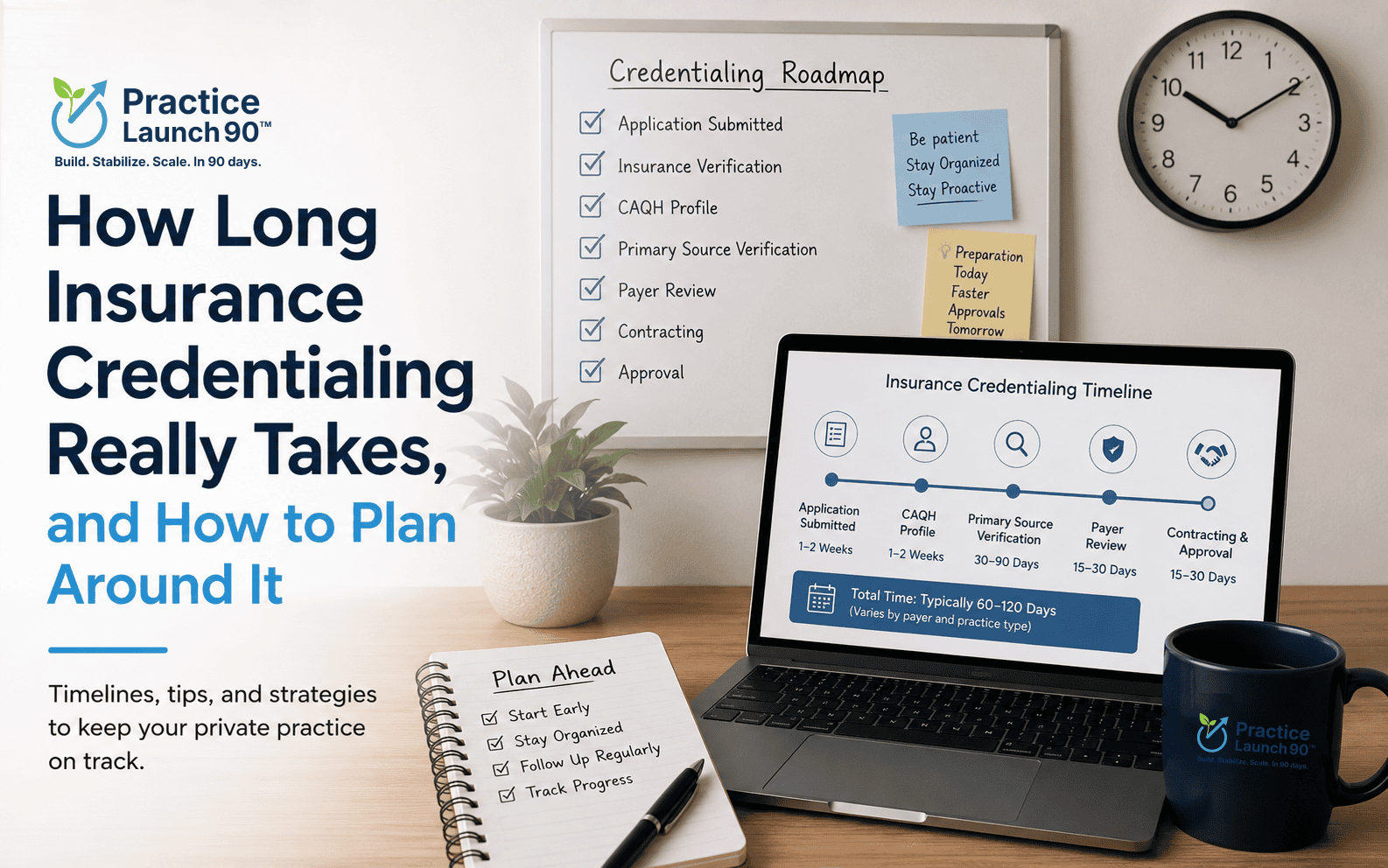
Plan for ninety to one hundred twenty days per commercial payer. Build your business plan around one hundred fifty.
That gap between the two numbers is the whole article. Ninety to one hundred twenty days is what happens when everything goes right. One hundred fifty is what you should have money in the bank for, because something usually does not.
Here is the part I want you to hear clearly, because clinicians tend to take this personally: the delay is not a reflection of you. It is not caused by your application being imperfect, and it is mostly not something you can speed up by trying harder. Credentialing runs on rules written by payers and accrediting bodies, and those rules have a clock built into them. Once you can see the clock, you can plan around it. That is a very different position than waiting and hoping.
Three separate clocks are running, and they do not sync up. Almost every delay traces back to one of them.
Most commercial payers pull your information from CAQH rather than from a form you fill out for each of them. You enter your credentials once, then authorize each payer to access them.
Two things about CAQH catch new practice owners. First, your profile is private by default. Completing it is not enough; you have to explicitly authorize each payer, and a profile nobody can see looks identical to a profile that does not exist. Second, you have to re-attest that your information is current every one hundred twenty days. If your attestation lapses, payers cannot pull your data, and any credentialing already in motion stalls quietly. Nothing breaks loudly. You simply find out weeks later that nothing moved.
CAQH is free for providers. The cost is attention, and the most common failure is that the reminder emails go to a practice manager who left.
Payers do not just read your application. They independently verify it against the original source: your license with the state board, your education with the institution, your malpractice history, your board certification, your work history, and exclusion checks.
Most payers follow standards set by the National Committee for Quality Assurance, and those standards changed on July 1, 2025. The window for completing primary source verification before a credentialing decision was reduced from one hundred eighty days to one hundred twenty days for accredited organizations, and to ninety days for certified credentialing organizations. NCQA also shortened the window for notifying you of a decision to thirty calendar days, and requires recredentialing every thirty-six months.
That change matters to you in a way that is not obvious. A shorter verification window means a payer cannot let your file sit in a queue for six months and then verify everything at the end. It also means that if any single verification comes back late, the whole file can fall out of compliance and the clock restarts. One slow response from a state licensing board can cost you a month, and nobody will call to tell you.
Verification finishing does not mean you are credentialed. A credentialing committee has to actually approve you, and committees meet on a schedule, usually monthly. If your file is verified two days after the meeting, you wait for the next one.
This is the step nobody warns clinicians about, and it is why a file that is technically complete on day seventy-five can still produce an approval on day one hundred five. There is no way to make a committee meet sooner. There is a very good way to make sure you do not miss two of them.
Medicare is not a commercial payer, and treating it like one is a common planning error.
For institutional providers, meaning the organizations that enroll on the CMS-855A, such as federally qualified health centers, ambulatory surgical centers, hospices, and home health agencies, CMS publishes its own step-by-step timeline. It is worth seeing in full, because it explains why enrollment feels so opaque from the outside.
| Step | What happens | CMS published processing time |
| 1 | The Medicare Administrative Contractor reviews the application: intake, screening, verification, fingerprints if applicable, then referral to the State Agency | About 30 days if submitted online, about 65 days on paper |
| 2 | The State Agency, or an Accrediting Organization, reviews the application and handles any required certification survey | About 45 days once a complete packet is received, and it varies by state |
| 3 | The MAC reviews the returned application and orders a site visit if one is required | About 10 days with no site visit, about 45 days with one |
| 4 | CMS Provider Enrollment assigns the CMS Certification Number and effective date and executes the provider agreement | About 30 days |
| 5 | The MAC issues the final approval letter | About 3 to 10 days |
Source: Centers for Medicare and Medicaid Services, Enrollment and Certification Roadmap for Institutional Providers.
Add those up honestly and the range is roughly one hundred eighteen days at the fastest realistic end, meaning an online submission with no site visit and no delays, to about one hundred ninety-five days at the slower end with a paper submission and a required site visit. That is four to six and a half months, and it assumes nothing gets returned for more information.
I want to be precise about who that applies to, because this is where most articles on this subject are simply wrong. That roadmap covers institutional certified providers. If you are a physician or a nurse practitioner enrolling as an individual or as a small group, you are on a different path, and it is generally shorter. The same logic applies to fees: the calendar year 2026 Medicare enrollment application fee of $750 applies to institutional providers, and physicians and non-physician practitioners do not pay a Medicare enrollment application fee at all.
If you are opening an FQHC or a surgical center, build six months into your plan. If you are a solo nurse practitioner, do not let those numbers frighten you, because they are not yours.
Almost every stalled file I have seen traces back to one of these, and five of the six are fully within your control.
Before you submit anything, get the sequence right
The Practice Preparation Checklist walks through what has to be in place before credentialing starts, including the license, entity, NPI, and malpractice items that hold up applications when they are handled out of order.
Free. No sales call attached to the download.
BUTTON: Download the Practice Preparation Checklist
This is the practical part, and it is why the timeline does not have to determine your opening date.
Start with private pay. A cash-pay or membership track lets you open, build a panel, and generate some revenue while enrollment runs in the background. It also forces you to price your services honestly, which is useful work regardless.
Open with whoever approves first. Payers do not finish together. Rather than waiting for a complete panel, plan to open when your first two or three payers come through, and add the rest as they land. Sequence your applications by which payers matter most to your expected patient population, and submit those first.
Use the retroactive window where it exists. CMS enrollment rules allow physicians and groups enrolling in Medicare Part B an effective date up to thirty days before the date the contractor receives the application, which means some services delivered during that window can be billed once enrollment is approved. Some commercial payers offer a retroactive effective date as well, and some do not. Ask each one directly, in writing, before you assume.
Then be careful about the trap in all of this. Retroactive billing recovers revenue eventually. It does not pay your staff in the meantime. Every dollar of retroactive claims is a dollar you have already spent months earlier. Plan your cash reserve on when money arrives, not on when it is earned.
Here is the sequence that works, counting backward from the day you want to see your first insured patient.
| When | What you are doing | Why it is in this order |
| Day 1 to 15 | Entity formation, NPI (type 1 and type 2), state license confirmation, malpractice quote and bind | Nothing can be verified until these exist. Malpractice in particular gates everything after it |
| Day 15 to 30 | Build the CAQH profile completely, attach every document, explain every work history gap, authorize each target payer | This is the file every commercial payer will read. Time spent here is recovered three times over |
| Day 30 to 45 | Submit Medicare enrollment and your top three commercial payer applications simultaneously | Applications run in parallel, not in sequence. Submitting one at a time is the single most expensive mistake in this process |
| Day 45 to 120 | Follow up every two weeks in writing. Re-attest CAQH if the window comes due. Track each payer separately | Silence is not progress. Files stall without anyone notifying you, and a written follow-up trail matters if you need to escalate |
| Day 90 to 120 | First approvals arrive. Confirm effective dates and any retroactive window in writing | Effective date, not approval date, determines what you can bill |
| Day 120 to 150 | Remaining payers approve. Open to insured patients, or expand from private pay | Build the buffer in here. If you needed it, you have it. If you did not, you open early |
At some point in this process, one payer will simply stop responding. No denial, no request for more information, no status change. Just nothing, for weeks.
Here is what works, in order. Follow up in writing every two weeks, not by phone alone, and keep the thread. Phone calls produce reassurance and no record. Email produces a timeline you can point to later. Ask three specific questions each time: what is the current status of the file, what is outstanding on your end, and what is the date of the next credentialing committee meeting. Vague questions get vague answers.
If two written follow-ups produce nothing, escalate to the provider relations representative for your region rather than the general credentialing inbox. Most payers have one, most clinicians never ask for one, and a named person behaves differently than a queue.
Keep your own tracker, one row per payer, with submission date, confirmation number, contact name, every follow-up date, and the committee meeting schedule if you can get it. This sounds like overkill until the month a payer tells you they never received an application you submitted eleven weeks earlier. At that point the tracker is the difference between starting over and pointing to a confirmation number.
Finally, check your own state. Some states set legal deadlines requiring payers to make credentialing decisions within a defined period, and some require retroactive effective dates once a decision is made. These rules vary considerably and change, so confirm the current position for your state with your state insurance regulator or medical society rather than relying on a national summary, including this one.
A sixty-day credentialing delay is not a sixty-day inconvenience. It is sixty days of rent, payroll, insurance, and software with no insured revenue against it, at exactly the point when you have the least cash on hand.
That is why credentialing belongs in your financial model rather than in your task list. In the previous article in this series I made the case that working capital, not the startup total, is what determines whether a practice survives year one. Credentialing is the single largest driver of how much working capital you need. The two questions are the same question.
Credentialing is executed by a specialized credentialing vendor that we coordinate as part of a Practice Launch 90 engagement. We do not perform the credentialing itself, and I would be suspicious of any firm that claims to do everything.
Whether you outsource it or handle it yourself, the honest test is time. Credentialing is not difficult work. It is detailed, repetitive work with expensive consequences for small errors, spread across months of follow-up. If you are also hiring, choosing an EHR, writing policies, and seeing patients, something gets dropped, and this is usually the thing that gets dropped. The question is not whether you are capable of doing it. It is whether it is the best use of the hours you have.
The clinicians who struggle with credentialing are almost never the ones who did it badly. They are the ones who started it late, because it felt like paperwork rather than like the thing that determines when money starts arriving.
If you are planning an opening right now, here is the question worth sitting with: what date have you told yourself you will open, and have you counted one hundred fifty days backward from it yet? If the answer puts your start date in the past, that is useful information, and it is much better to learn it today than in month four.
Not sure where your timeline actually stands?
In a thirty minute strategy session we will map your credentialing sequence against your opening date, identify which payers to submit first based on your expected patient population, and tell you plainly whether your target opening is realistic.
If it is realistic, you will leave with the sequence. If it is not, you will find out now rather than in month four.
How long does insurance credentialing take?
Plan for ninety to one hundred twenty days per commercial payer, and build your financial plan around one hundred fifty days. The range exists because three separate processes have to complete: your data file has to be current and authorized in CAQH, the payer has to independently verify your credentials against primary sources, and a credentialing committee has to meet and approve you. Committees typically meet monthly, so timing relative to that calendar can add weeks on its own.
Can I see patients before credentialing is finished?
Yes, and many practices do. The two common approaches are opening on private pay while enrollment runs in the background, and opening as soon as your first two or three payers approve rather than waiting for a complete panel. CMS enrollment rules also allow physicians and groups enrolling in Medicare Part B an effective date up to thirty days before the contractor receives the application, which permits limited retroactive billing once enrollment is approved. Confirm each commercial payer’s retroactive policy in writing, because they differ.
What is the most common cause of credentialing delays?
In practice, it is rarely one dramatic problem. It is a CAQH profile that was completed but never authorized for that specific payer, an attestation that lapsed because reminders went to an old email address, an unexplained gap in work history, a document that expired mid-process, or an address that does not match across the license, NPI record, and application. Each is small. Each can cost a month.
Do I need a CAQH profile, and how often do I have to update it?
Most commercial payers pull credentialing data from CAQH rather than from individual paper applications, so in practice yes. CAQH requires providers to re-attest that their information is accurate every one hundred twenty days. It is free for providers. Two details matter: the profile is private until you explicitly authorize each payer to access it, and a lapsed attestation stops payers from pulling your data, which stalls any credentialing already in progress without an obvious warning.
How long does Medicare enrollment take?
It depends entirely on what you are enrolling as. For institutional providers such as federally qualified health centers, ambulatory surgical centers, and home health agencies, CMS publishes a five-step process whose stated processing times total roughly one hundred eighteen days at the fast end and about one hundred ninety-five days when a paper submission and a site visit are involved. Physicians and non-physician practitioners enrolling individually or as a small group follow a different and generally shorter path, and they do not pay the $750 application fee that applies to institutional providers.
Should I hire a credentialing service or handle it myself?
The work is not intellectually difficult, but it is detailed, repetitive, and spread across months of follow-up, and small errors are expensive. The honest question is not whether you can do it. It is whether you can do it consistently while also hiring staff, selecting an EHR, writing policies, and seeing patients. Most clinicians can do any one of those well. Very few can do all of them at once, and credentialing is usually the one that quietly slips.
Jenn Mayhew, MPH, PMP, LSSGB, is the founder and principal consultant of Vermont Healthcare Consulting, LLC, and leads Practice Launch 90, the firm’s national practice transformation division. She has more than thirteen years of consulting experience across hospitals, federally qualified health centers, behavioral health providers, state agencies, and nonprofits, and was named the 2026 SBA Vermont Woman-Owned Small Business of the Year. Vermont healthcare consulting services is a certified Woman-Owned Small Business and Economically Disadvantaged Woman-Owned Small Business.
Practice Launch 90, a national division powered by Vermont Healthcare Consulting.