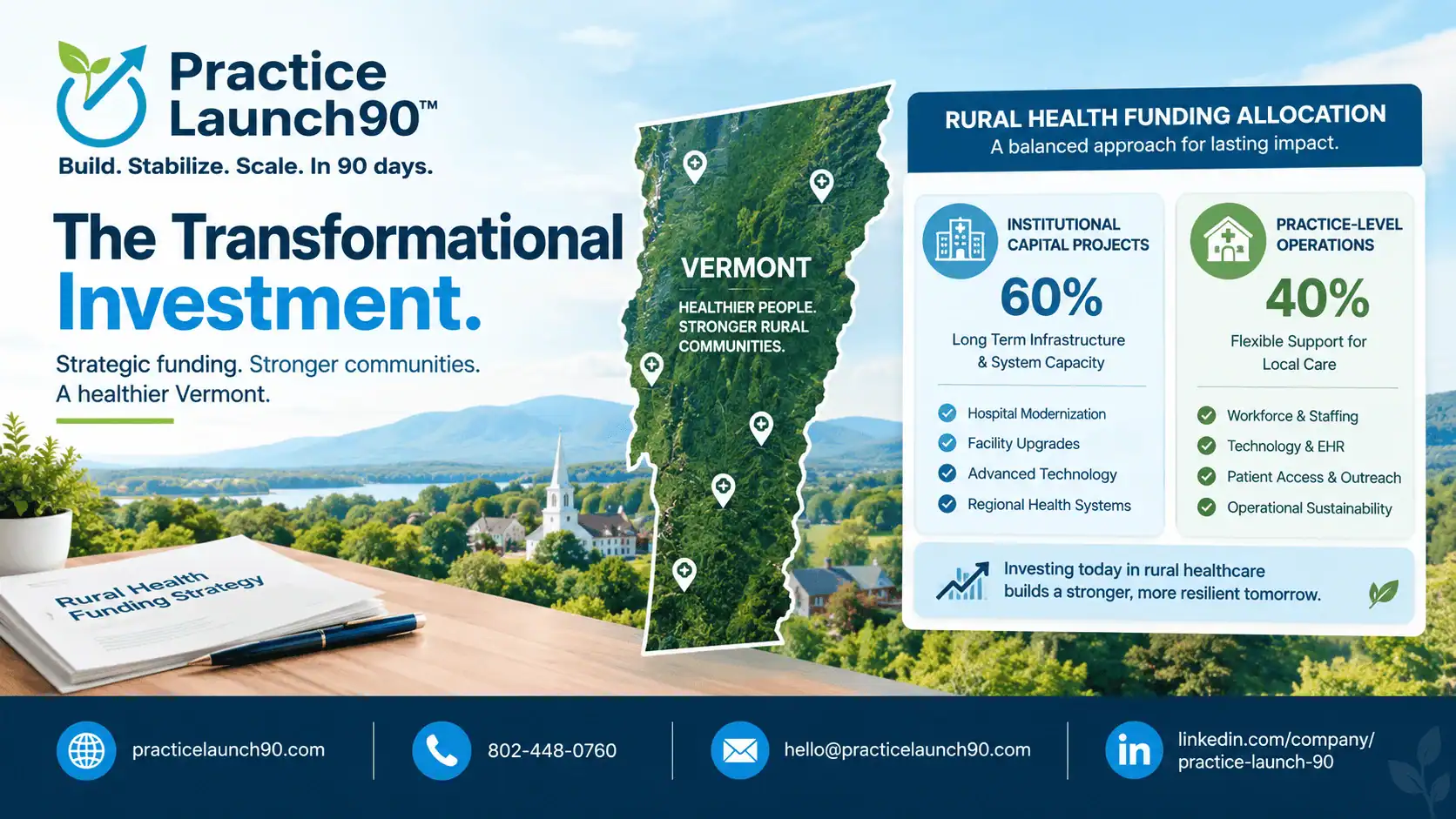
On December 29, 2025, the Centers for Medicare and Medicaid Services announced awards under the Rural Health Transformation Program, a 50 billion dollar federal initiative running from fiscal year 2026 through 2030. Vermont’s first year award is 195,053,740 dollars, which state officials have described as nearly full funding of the proposal Vermont submitted. The Agency of Human Services is administering the program, and the money arrives as a cooperative agreement with CMS, which means federal involvement in oversight and reporting throughout.
By any measure this is a remarkable amount of rural health transformation funding for Vermont, a state where a single hospital budget cycle can dominate policy debate for a year. The question that matters now is not whether the money is welcome. It is where the money should go, because the choices made in the next year will decide whether this investment produces lasting change or a five year sugar high.
The Temptation: Buildings and Institutions
Large healthcare investments historically gravitate toward capital projects and institutional support. Buildings are visible, announcements photograph well, and struggling institutions have urgent needs that are easy to understand. Some of that spending is genuinely necessary. Vermont’s rural hospitals face real financial distress, and stabilizing essential emergency and inpatient capacity is a legitimate use of funds.
But the last decade offers a caution. Nationally, more than 200 rural hospitals have closed or converted away from inpatient care since 2010, many of them after receiving support intended to save them. Money that flows only to institutions inherits the fragility of those institutions. If the goal of rural health transformation funding in Vermont is durable access for rural Vermonters, the portfolio needs a second layer, one that survives even when an institution does not.
The Opportunity: Fund Operational Capability, Not Only Capital
Here is where I thought there could be real value in offering a practitioner’s perspective. After more than a decade of consulting work inside Vermont hospitals, federally qualified health centers, behavioral health agencies, and state government, the pattern I see repeatedly is that rural access rarely fails for lack of buildings. It fails for lack of operational capability: clinicians who cannot get through payer enrollment, practices that collapse under billing problems, small organizations that cannot afford the administrative infrastructure larger systems take for granted.
These are exactly the problems a transformation program could solve at modest cost. Consider what even one percent of Vermont’s award could do if directed toward practice level capability. It could fund insurance credentialing for new practice launches in underserved towns, so clinicians start seeing insured patients months sooner. It could provide shared billing and compliance support for independent practices too small to hire their own. It could underwrite technical assistance for clinicians learning how to start a private practice in communities that have lost other options. None of this photographs as well as a ribbon cutting. All of it produces access points that keep working after the program ends.
Three Principles for Spending the Money Well
Count independent practices as infrastructure. A clinician owned practice in a rural town is an access point with a cost structure lean enough to survive rural volumes. Program design should make independent and small group practices clearly eligible, not an afterthought squeezed into definitions written for institutions.
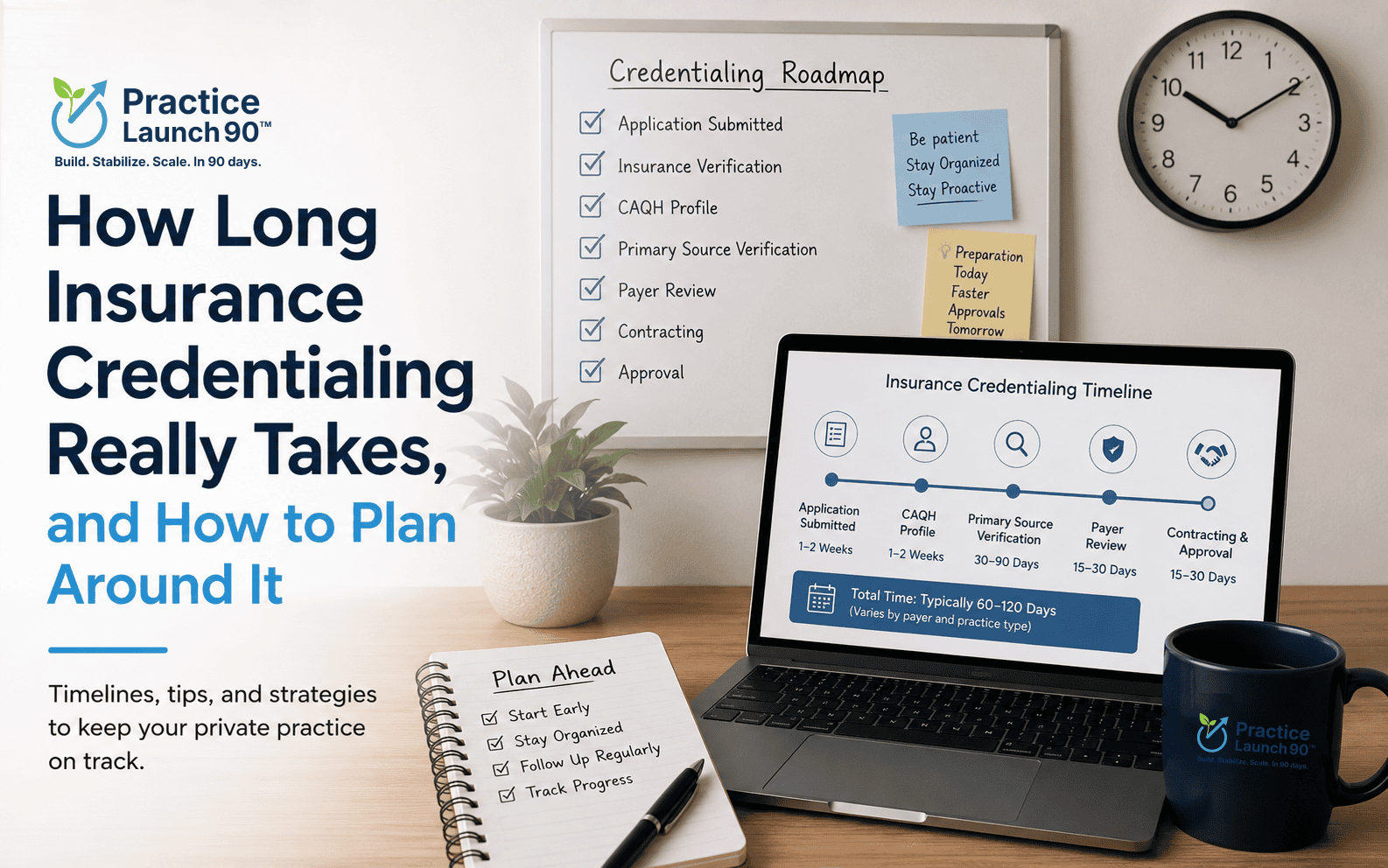
Fund the unglamorous foundations. Credentialing assistance, billing infrastructure, compliance support, and workforce onboarding are the difference between a practice that opens and one that endures. Insurance credentialing for new practice sites alone routinely delays rural access by months, and it is a solvable problem with targeted support.
Build for the year after the funding ends. Every funded initiative should answer one question in writing: what keeps this alive in 2031? Operational capability, once built, persists. Subsidized operating losses, once the subsidy ends, do not.
Leading an organization that plans to engage with this program? Book a free strategy session and we can talk through positioning and readiness.
What Vermont Clinicians Should Do Now
For clinicians, the practical guidance is straightforward. First, follow the Agency of Human Services as it releases program details and requests for proposals, because eligibility definitions and funding priorities are still taking shape and public comment windows matter. Second, get your own house in order. Organizations with clean financials, active credentialing, and documented community need will be far better positioned for any funding stream than those scrambling to assemble basics. Third, if you have been weighing how to start a private practice in a rural community, this policy moment strengthens the case for planning seriously now, so that you are operational when opportunities arrive rather than reacting after they close.
The same applies to existing practices considering expansion into underserved areas. Funding programs reward readiness, and readiness is built months in advance. In practical terms that means current financial statements, an active and accurate provider enrollment file, a clear description of the population you serve, and a short written case for why your services address a documented rural need. Organizations that can hand a reviewer those four things on request will move faster than organizations that cannot, in this program and in every one that follows it. The same checklist, incidentally, is the backbone of how to start a private practice well in the first place. This preparation is also where clinician practice ownership consulting earns its keep, well before any application deadline appears.
Where Vermont Healthcare Consulting and Practice Launch 90 Fit
Vermont Healthcare Consulting is a Williston based firm, certified as a woman owned small business and an economically disadvantaged woman owned small business, with a 13 year record across Vermont hospitals, federally qualified health centers, behavioral health providers, state agencies, and nonprofits. Through Practice Launch 90, our national practice transformation division, we provide clinician practice ownership consulting for providers launching, stabilizing, or scaling independent practices, including clinicians figuring out how to start a private practice for the first time, along with the credentialing, billing, and operational systems this article argues the state should treat as infrastructure.
We offer clinician practice ownership consulting to practices at every stage, and we work with organizations preparing for state and federal funding opportunities. If rural health transformation funding in Vermont ends up supporting practice level capability, we want every clinician reading this to be ready to use it well. If it does not, the case for building that capability yourself only gets stronger.
Want an honest read on your readiness? Schedule a free strategy call with our team.
Frequently Asked Questions
What is the Rural Health Transformation Program?
It is a 50 billion dollar federal initiative created in 2025 and administered by CMS, distributing funds to all 50 states from fiscal year 2026 through 2030 to strengthen rural healthcare access, workforce, technology, and care delivery. States applied in late 2025 and awards were announced on December 29, 2025.
How much rural health funding did Vermont receive?
Vermont’s first year award is 195,053,740 dollars, announced by CMS on December 29, 2025. State officials have described the award as nearly full funding of Vermont’s proposal. Awards in later years depend on program requirements and federal decisions.
Who decides how Vermont spends the money?
The Vermont Agency of Human Services administers the program under a cooperative agreement with CMS, which retains oversight and reporting requirements. Program priorities, eligibility, and procurement are being defined through state processes, including requests for proposals.
Can independent practices benefit from this funding?
Eligibility depends on how Vermont structures its programs, and definitions are still being finalized. Providers outside strictly rural counties may qualify for projects that demonstrably serve rural communities. Practices should follow Agency of Human Services announcements closely and be ready to document rural impact.
Is now a good time to open a practice in rural Vermont?
The policy environment is unusually favorable to rural access, but a practice should stand on its own economics regardless of any program. Careful planning around how to start a private practice, including realistic volumes and payer mix, matters more than any single funding stream.
What is the biggest operational barrier for new rural practices?
In our experience it is the administrative launch sequence, especially insurance credentialing for new practice sites, which can take months and delays revenue long after a clinician is ready to see patients. Starting credentialing early, with clean applications, is the single highest value move for anyone learning how to start a private practice.
The Bottom Line
Vermont has been handed a rare policy moment and a serious sum of money. The safest prediction is that institutions will absorb most of it, and some of that is appropriate. The better outcome is a portfolio that also treats practice level capability as infrastructure, because rural health transformation funding in Vermont will be judged not by what it announced but by what is still standing when it ends. Independent practices, properly launched and supported, are what still stands. If you have been asking how to start a private practice in this environment, the answer begins with a plan, not a program.
Whether you are planning, stabilizing, or scaling, start with a conversation. Book your free strategy session with Practice Launch 90.